

How To Install Basement Window In Block Wall
Basement Waterproofing: How to Install a Basement Drainage System
Install a sump pump every bit part of your basement waterproofing arrangement.
 Time
Time
Multiple Days
 Complication
Beginner
 Cost
Cost
$501-1000
Introduction
Is your basement always damp? Practise Apr showers bring a wet basement along with those May flowers? Then it might be time to consider waterproofing your basement and installing a drain organisation with a sump pump. A wet basement not only prevents you lot from enjoying additional infinite in your house but also can turn your basement into a behemothic petri dish perfect for growing unhealthy molds and fungi.
Tools Required
Materials Required
- 30- to 36-inch-deep sump pump basin
- iv-in.-bore Schedule 10 perforated pipe
- Concrete mix
- Duct tape
- Irrigation hose
- Irrigation pipe
- Masking tape
- River stone
- Sail plastic
- Sump pump
A Dry out Basement is a Useable Basement
Installing a basement drainage system is filthy, backbreaking work, but it'south non complicated. With a piffling instruction from our bleed tile experts, you can practise a first-class basement drainage task. And DIY pays off big: Pros charge $5,000 to $eight,000 for a typical basement drainage task (120 linear feet of bleed tile). Yous can install yours for less than $one,500 in materials and tool rentals.
Earlier Yous Become Started With a Basement Drainage System:
It's always all-time to stop h2o from entering your basement in the commencement place, and then before you run to the rental eye for your jackhammer, be sure to accost the outside issues. The grade next to the house should slope down away from the edifice by least half-dozen in. for the first ten ft. Consider installing gutters, or brand sure the existing gutters are working properly. And check that your irrigation system isn't adding to the trouble by spraying water correct up against the side of the house.
If You Have a Finished Basement:
If your basement is finished, with stud walls and insulation covering the foundation walls, you tin still install a basement drainage arrangement. When you lot suspension out the physical, exit small sections of floor intact and then the wall doesn't drop down. A 4 10 4-in. section every 6 ft. is enough to support the wall. If there are obstacles along the wall (similar a furnace), plan to tunnel under them. You'll discover most of the materials you'll need at a home eye. Order the stone from a landscape supplier. Y'all'll besides need a pickup to haul the dirt to the landfill.
Always check with your local building official. Explain your project, and see if any permits or inspections are required in your surface area. Sometimes, a building official who has been around for a while may have data on how your house was built or what issues you may run into in your surface area.
Radon! A bleed tile system creates a perfect pathway for dangerous radon gas to escape. If you've never tested for radon, it'due south smart to do and so before you install a drain arrangement. That way, you can program for a radon mitigation system as well.
Is radon testing required to sell a house? Find out here.
Project footstep-by-pace (11)
Step 1
Meet the basement drainage experts

Rite-Way Waterproofing has been in the business of installing waterproofing basement drain systems since 1965. The pros at that place know what works, and they'd better because the company has installed 100,000 systems, each with a lifetime guarantee. They also know what doesn't piece of work—half of Rite-Way'south current jobs involve replacing failed systems installed by other contractors.
Footstep 2
Control the Grit

There's no getting effectually it: Busting upwards physical is a dirty job. Shut down your furnace or central air conditioning while you're working, and cover all return air vents until you lot're finished cleaning up. Instead of covering your furnishings with plastic, move everything out of the area and drape plastic from the ceiling to create an isolated workspace. If yous accept an unfinished ceiling, be sure you run the plastic upwardly into every joist space. Gear up a fan in the window to exhaust the heavy grit while you run the jackhammer. And wear a dust mask and hearing protection. Check out more ways to protect your habitation during remodeling projects.

Pace iii
Bust Up the Floor

The pros use electrical jackhammers because the air that runs pneumatic jackhammers kicks up a lot more dust. You can become one from a rental centre for under $100 a mean solar day. Start by hammering a line about 16 in. to 18 in. away from the wall. Start by chipping in a directly line along the unabridged length of the wall, then come up back and bust it into manageable chunks.
Once the perimeter is washed, come dorsum and break the row of concrete into manageable chunks. Each section will break complimentary easier if it has room to pull abroad, so remove the sections equally yous go. If you're working alone, make the almost of your rental time; merely set the chunks aside until you're done with the hammer. Don't forget to bust up a larger area for your sump basin.
Footstep 4
Dig a Trench Along the Wall
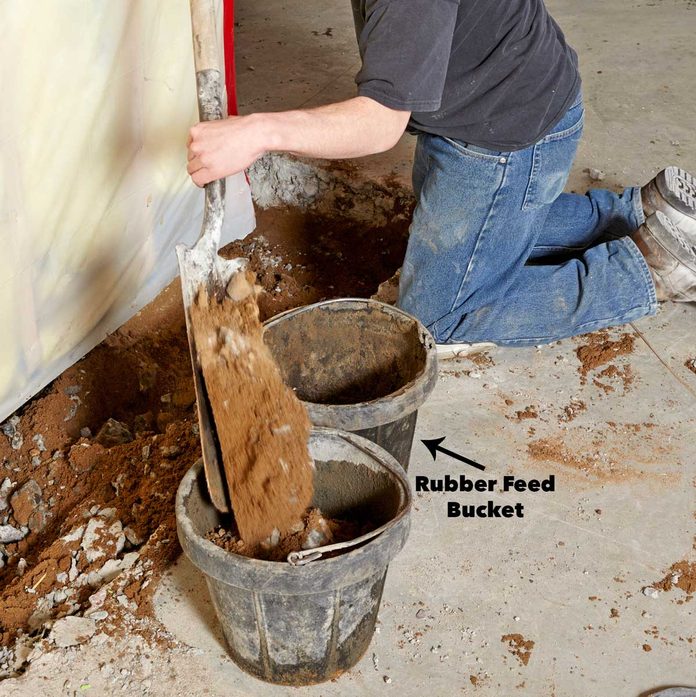
Once the concrete is removed, dig down to the bottom of the footing but non below. If you compromise the soil under the footing, y'all could terminate up with cracks in your wall, or worse.
Instead of lugging pails of soil upwards the stairs, purchase buckets that will fit through your basement windows. Five-gallon buckets are OK for hauling out debris, but the guys at Rite-Style utilise rubber feed buckets (typically used for farm animals) because they fit through small-scale basement windows and are less likely to bang up trim. You can get them at farm supply retailers for nether $20. And when information technology'south time to booty the debris away, you may notice that the landfill considers information technology to be "make clean fill." You may be able to dump it for free!
Footstep five
Install the basement drainage basin
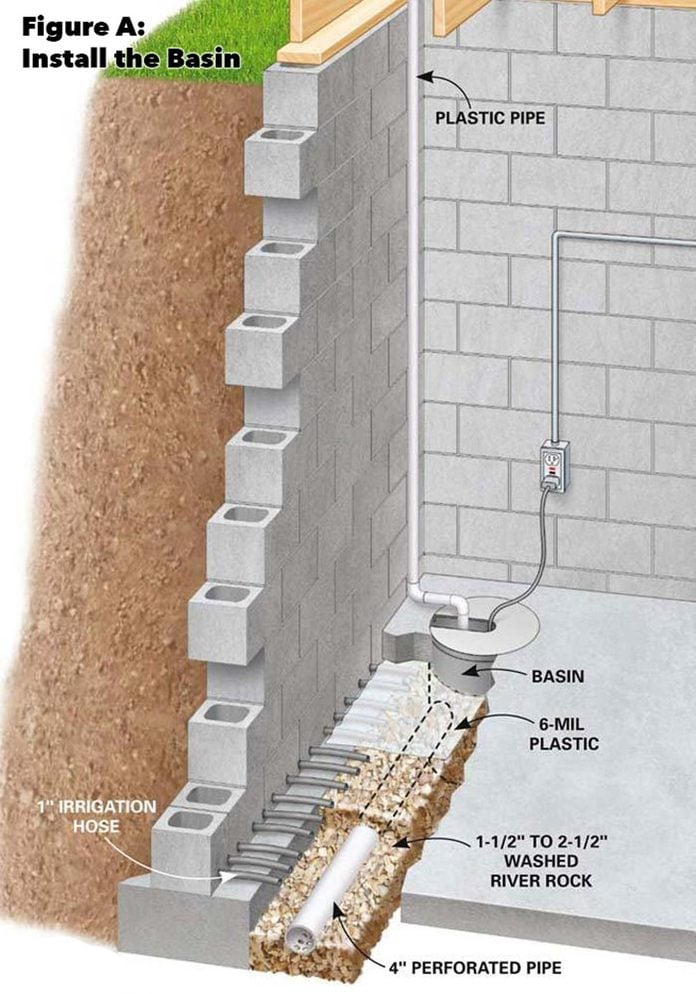
It's best to locate your basin in an unfinished expanse of the basement so you can take easy admission to the sump pump. If you never plan on finishing the basement, locate the bowl in the same expanse where you want the water to bleed out of the house and so you don't have equally much plastic pipe to install. Dig the pigsty then the top of the basin will sit down flush with the finished concrete.
Basin "Knockout" Areas:
Many basins come with flat "knockout" areas meant to make cutting the hole easier. Don't assume the location of these knockouts will work for your system. Because the piping will be slightly sloped down toward the basin, the longer the drain is, the lower the piping will exist when information technology reaches the bowl. You lot never want continuing water in your drainpipes, so make sure to choose a model that is deep enough. Our experts typically use thirty-in.-deep basins. They use 36-in.-deep models for systems longer than 120 ft., and they install ii basins if the drain is longer than 180 ft.
Drill holes in block:
If your waterproofing basement walls are made from concrete block, drill i-in. holes in each cake core and into each mortar joint (Effigy A). This volition let the h2o that collects in the cores and between the blocks to flow into the drain. Drill the holes as close to the footings equally you can. You may notice that the bottom blocks are filled with concrete. In that instance, yous'll have to remove whatever existing walls and install foundation wrap. Cut down on grit past laying a shop vacuum hose adjacent to the hole every bit you drill.
Footstep half-dozen
The Water Basin Basement Drainage Organisation

Set the basin in identify, and and then mark the locations for the holes where the pipes will run across the basin. Keep in mind in that location will exist a thin layer of rock (ane layer thick) under the pipe almost the basin. Cutting the holes using a reciprocating saw, jigsaw or hole saw. The holes don't have to be perfect.
Don't haul out all the dirt right away; you'll need some to fill in effectually the basin. Once it's permanently in place, fill up in effectually it, tamping the dirt with a 2x4 as you lot get.
Never drill holes in the bottom of the basin! If you have a high water table, water could come up from the lesser, and your pump volition run nonstop, attempting to dry out the neighborhood.
Footstep seven
Install the Pipe

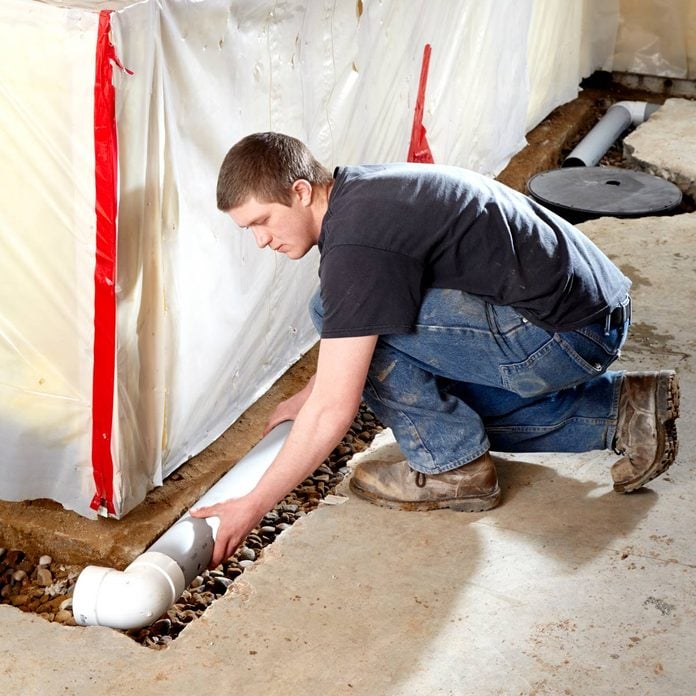
Before you lay the pipage in the trench, shovel in a bottom layer of 1-ane/2-in. to 2-in. done river rock (a layer of smaller rock can become chock-full with minerals and sediments). The pipe should slope toward the basin at to the lowest degree one/4 in. for every 10 ft. Rake the rock around to reach this pitch.
Lay pipe on top of the stone:
Lay your irrigation piping on pinnacle of the rock. Don't use ordinary flexible drainpipe because it clogs easily. The pros prefer to lay downwardly a 4-in.-diameter Schedule 10 perforated pipe. Buy the kind of pipe with rows of 1/2-in. perforation holes only on one side, not all effectually the pipe.
Lay pipe on with holes facing downwardly:
Lay the piping with the holes facing down, and then the minerals and sediment in the water tin flow down around the pipe and settle into the ground. This way, the water that does rising upwards into the pipes from underneath volition be relatively make clean. Clean water volition add years to the life of the whole system. Start at the basin, and push the male person end of the pipe into the basin about 4 in. Use PVC or ABS elbows at the corners. It'south not necessary to cement the sections together.
Plus: What should you practice with leftover PVC pipe? We've got some bright ideas for you.
Footstep 8
Divert the Water Into the Drain

Drill 1-in. holes in each block core and each mortar joint. Once your pipe is installed, it's time to install the 1-in. irrigation hose that will acquit the h2o from the blocks to the trench. A softer hose, similar a garden hose, can get crushed flat by the new physical, so stick with irrigation hose. Cut the hose with a hacksaw or reciprocating saw. Brand sure each section of hose runs several inches past the footing.
Pace 9
If You Have a Solid Physical Foundation
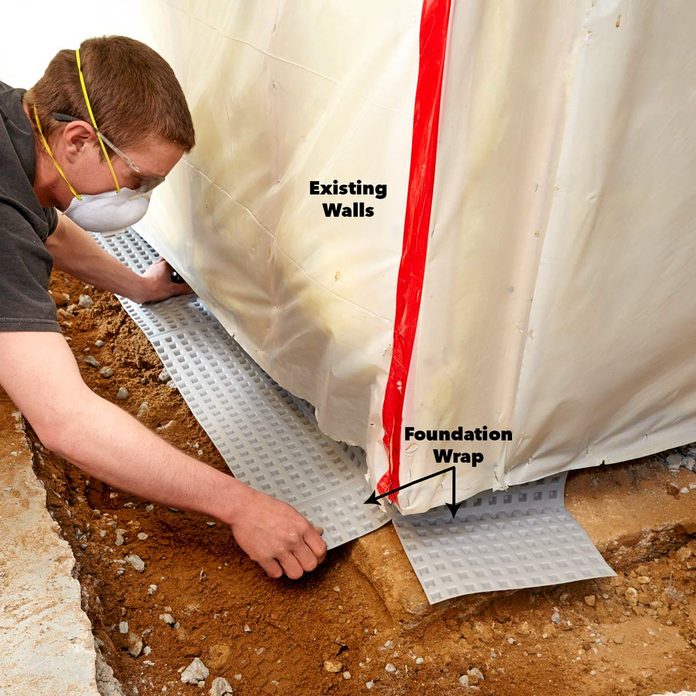
If you take poured concrete walls rather than block, you'll need to install a foundation wrap to let the water into the drain equally shown below. Foundation wrap is made from tough plastic and consists of rows of dimples that allow water to flow behind it.
Cut the sheets into strips with a utility knife. Bend the strips at 90 degrees and let the bottom half run past the footing. The length of the wrap that's up against the wall depends on your state of affairs. At a bare minimum, run the wrap up 4 in. in a higher place the top of the concrete on a poured wall, or upwards 4 in. past the holes, y'all drilled in the cake wall. If you're working along stud walls, endeavour to tuck the wrap behind the bottom plate.
Stride 10
Cover It Back Up
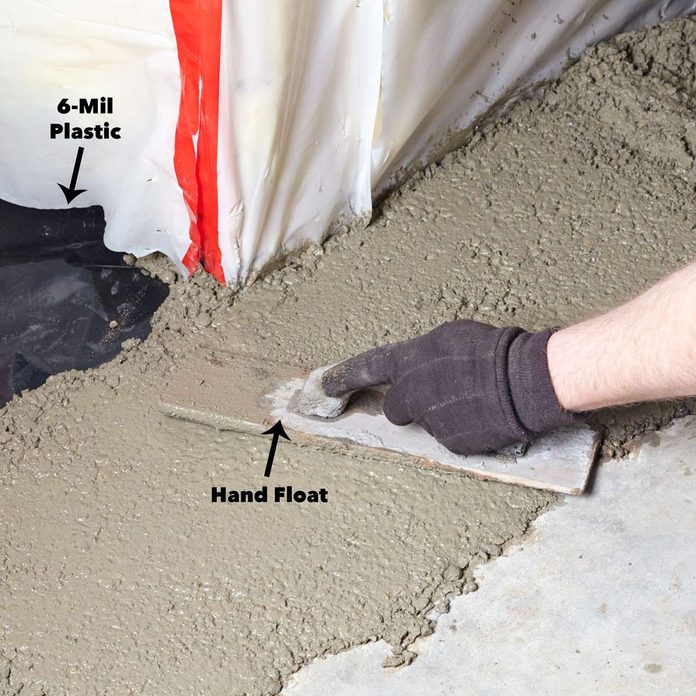
Once the hoses are in or the foundation wrap is in place, it's time to cover it upwardly. Fill in the trench with river rock up to the bottom of the existing slab, and then cover the rock with at least a 6-mil thickness of plastic for a vapor barrier.
To cut down on dust, mix your physical outside. Bagged concrete mix for slabs and sidewalks works just fine. Slide a 3-ft. section of 2x4 forth the floor to "screed" the new concrete flush with the flooring, and and then smooth information technology out with a paw float. Wait 20 minutes, then polish information technology with a finishing trowel. Utilise the bladder to completely fill the gap under any existing walls.
Step xi
Hook Upwards the Pump
Pros prefer submersible pumps that accept a vertical float switch on them considering they're more than reliable than pedestal or bladder switch pumps. Install a 6- to 8-in. section of pipe on the pump, then a check valve. Make certain the check valve doesn't interfere with the pump switch. To a higher place the check valve, attach another department of pipe long enough to reach above the tiptop of the basin.
Drill a 1/4-in. to iii/8-in. vapor lock release hole in the section of piping that's just below the check valve (see Figure B). This allows the pump to get up to speed before trying to force open the cheque valve, which may have many gallons of h2o pressing downwardly on information technology. Angle the hole so h2o sprays downwards while the pump is working. It'southward all-time if you take a defended outlet for your pump. Extension cords get unplugged, and other appliances hooked upwards to the aforementioned excursion could trip a billow.
The pipe that exits the basement needs to be located in an area that slopes abroad from the house. If that means running a pipe dorsum across the basement, consider burying the waste product pipage in the trench and having information technology come support where you desire it. If your pipage is going to discharge above class and you alive in a cold climate, run the pipe no more than 8 in. by the siding. This volition keep it from freezing upward in the wintertime.
With few exceptions, basement drain water cannot be dumped into city sewer systems. Near systems can be drained into tempest sewers as long as they're above class when they do. Ask your building official what the rules are in your area.
Side by side, learn how to finish the remainder of your basement hither.
Originally Published: February 15, 2019
Source: https://www.familyhandyman.com/project/how-to-waterproof-a-basement/
Posted by: farlowatuddrefould.blogspot.com
0 Response to "How To Install Basement Window In Block Wall"
Post a Comment